This chapter is indeed a hodgepodge of topics that the authors apparently couldn’t fit anywhere else, but knew needed to be addressed.
Digital divide, edivide or information divide – it’s all pretty much the same. Folks don’t have access to the benefits derived from having access to technology, computers, and/or the internet. I understand why the authors did such a cursory review of this – after all, the book is about using Web 2.0 tools in the classroom.
When I think of the digital divide I think of kids in public housing (or other low income children) who don’t have access to a computer or the internet at home. I know that they have access to computers at school, in the library, probably in their Parks and
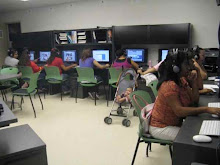
These centers do fill a need. Both the library labs and our computer labs are usually full after school. This means we usually have to impose time limits, a definite hindrance when a child is doing homework. (If there are people waiting, we usually impose a 30 minute time limit unless a person is doing homework then we give them 60 minutes.) It doesn’t change the fact that they don’t have these resources at home like many middle class families, but it is available.
HOWEVER, teachers shouldn’t assign an entry to a blog, for instance, as homework if the student doesn’t have access at home and time isn’t given in class. (If you take a bus in our neighborhood, it’s one bus or nothing.) This leads me to one of my soapbox topics. How can teachers in low-income neighborhoods assign such work? We have 5th graders coming to our lab to type reports because teachers say they won’t accept them if they’re hand written. I have kids being assigned to produce PowerPoints. If these were “slacker” kids, I might understand, but they’re not. Enough. On with the blog.
Somewhere I read this week that we look at problems the way we’ve been taught to look at problems. We filter them through a sieve of information and then look at the notions and solutions that we’ve used before to find an “answer.” In the interests of the economics of time, we usually don’t even look for a 2nd possible solution. We just think, “aha, problem solved, time for next task.” Most of us are not taught to look at issues in any other way. The point was that we don’t search for creative solutions. We need to relearn how to look at the challenges the world faces. AND we need to teach children to use their innate creative talents when solving problems.
This hit me square between the eyes when I started pursuing the digital divide angle. I am so insular. After reviewing a few sites, I realized I had no concept of what the problem really is, let alone an answer (contrary to the edivide quizzes on think.quest.com).
Jakob Nielsen, a website guru who helps businesses develop usable websites (http://www.useit.com/alertbox/digital-divide.html), says there’s a usability divide. He says that even if we gave everyone computers using them is so convoluted that most people would have difficulty using it effectively. The issue, he says, is that 40% of the population has lower literacy skills and very few companies or web site designers use the guidelines for writing for low literacy users. At http://www.useit.com/alertbox/20050314.html, he has a number of insights and suggestions for writing text and designing web sites that are user friendly for persons with lower literacy. (Great for our discussion about persons with disabilities, too)
Another thing brought to my attention by this search was the language divide. Even if we connected everyone in the world, there’s a huge language imbalance. Over 65% of web sites are in English with Japanese and German, the next two largest, trailing with 5.9% and 5.8% respectively. As we close the connection divide, we need to ensure there’s something for people to connect to.
This report caught me off guard (http://www.isse.ucar.edu/infodivide/). I don’t know what I thought, but I guess with the wealth of weather information we have available in the
The Ugandan satellite system is a desktop computer that I wouldn’t have in one of my neighborhood network centers. One of the “supercomputers” for weather in
One of the strident websites visited, http://www.digitaldivide.org/dd/index.html, connected the digital divide with terrorism, among other things. (I have to say that I had a hard time with this, but looked it up and, sure enough, these folks weren't the only ones that had this theory.) Basically, the idea is that if the rural areas that allowed terrorists to live and train in them were more aware and had better economic opportunities (though an internet connection, I presume) then there would be less terrorism. I found this an interesting perspective. One of the examples was
From this same web site (info which I verified with other sites), I learned that
http://en.wikipedia.org/wiki/Indonesia
http://www.expat.or.id/info/overview.html
As I thought about it, I wondered, is
By the way. thinkquest.com has a nice page of information, quizzes and games that deals with the digital divide. This is an area primarily for educators, but it certainly wouldn’t hurt to have kids in this country understand the extent of the global digital divide.




 Posts
Posts


Thank you for the focus on the digital divide. You certainly have found some interesting info.
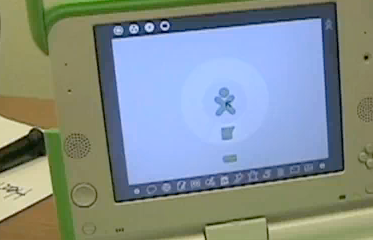
ReplyDeleteWhile you put your finger on the primary reason the text doesn't go into it more, there also is the situation that there are few solutions in sight. That is one of the reasons Negroponte's OLPC program is so interesting. 'Tis about the only game in town that really is trying on a grass roots level to address the issue - particularly when one considers the magnitude of scale any meaningful solution would require.
I have heard the terrorist thing before. Apparently there are some tenants in Islamic society, at least as some interpret them, that work against technology and business development. So, there is a cultural issue that condemns the practices that make development possible, coupled with an envy of the products of those "unholy" acts. Some aspects of the Arabic world that feed terrorism go beyond economic or technology challenges to cultural considerations.
As you found, in your research, there is quite a bit of information, that can be spun all sorts of ways, depending on the analysis. Unfortunately, the end result seems to come back to just a good bit of frustration.