Random thoughts and web wanderings about internet safety and kids
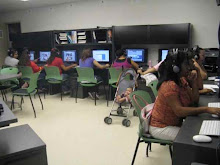
I have always believed that safety on the internet was common sense. Talk to your kids, keep the computer in a public place, monitor their accounts. But now I wonder. I wonder about the computer labs that the Housing Department, my section specifically, monitors. Our labs are staffed at all times, but there’s only one facilitator per lab and there are 15-20 stations and almost all of them are filled afterschool. What is really happening there and do I have enough resources to find out?
This site, http://www.foxnews.com/story/0,2933,366181,00.html, says that 71% of parents think their child is using the internet for school work, only 23% of kids say they’re using it for school. How can we be so out of touch with reality?
The Office of Juvenile Justice (OJJ) provided me with new food for thought. Some researchers find that pedophiles are finding acceptance for their criminal choices through sites such as the Man/Boy Love Association. In essence, a pedophile joins other pedophiles (not so easy before the internet) for extended support groups for their negative behaviors. These acts (or thoughts) are validated through exchanges with others on the sites. If the thoughts are approved of by others, it makes it so much easier to do. http://www.ojjdp.ncjrs.gov/jjjournal/jjjournal598/net.html
I think this might be an effective strategy for parents of younger children who use the web, but I’m not so sure about its effectiveness with teens. OJJ and others suggest that families have their children sign agreements for safe practices on the web. The National Center for Missing and Exploited Children gives advice on the possible rules such as not giving out personal information, never agreeing to meet in person with someone, telling parents if online conversations are making them uncomfortable, etc. The signed agreements should be posted near the computer as a daily reminder.
This article from a PBS columnist who cited author Benjamin Radford puts the 1 in 5 statistic about children being approached into a little perspective saying that of those, none had actually had any sexual contact with a predator. For those kids who had actually had some type of solicitation from an online source (gift, phone contact, request to meet) the figure is more like 3%. Even then, that means that if you have a class of 30 kids, odds are that one of them has been approached. http://www.pbs.org/teachers/learning.now/2006/05/online_predators_much_ado_abou.html
The author also says that many of the sexual advances online are from other teens. Super! That makes me feel so much better. It also brings us to cyberbullying. I can’t remember where I heard or read this recently, but the source said that schools put most of their effort into curbing cyberbullying rather than addressing other internet safety issues. I find that hard to believe, but maybe it’s true. My son just graduated from high school and I don’t remember him ever mentioning cyberbullying.
Of course, on the web, one reads the absolutely horrific stories about children who have committed suicide because of these hate crimes; however, I can also imagine this happening. Children are frequently mean to others and I can well imagine that email, IMs and text messaging are just more weapons in the arsenal of meanness. The anonymity of the internet and the ability to create false identities adds a twist to bullying.
Several sites mentioned that girls are more prone to use this tactic than boys. One online survey conducted by researchers showed that over 1/3 of the girls reported being bullied online. About 30% said they responded with bullying of their own. Cyberbullying ranges from calling each other names to death threats.
http://meganmeierfoundation.org/resources/
http://www.cyberbullying.us/cyberbullying_girls_victimization.pdf
I listened to an enhanced podcast by Joseph Bires who is a technology coordinator for a school district. I listened because his topic was Acceptable Use Policies and Web 2.0; however, his presentation made me think about a few things. If the Read/Write web makes 24/7 learning possible, when do the AUP rules begin and end? When a student uses Wikipedia as a source, to whom is it attributed? Should AUPs be the same for all ages? http://edtechleadership.com/wordpress2/
Len Scrogan, another technology coordinator, brings some more interesting points to the discussion. Does your AUP include mobile technologies such as cell phones and PDAs? How does your school handle pictures taken at a school sponsored function (football game) by another student who then posts it to the web?
He suggests that we use AUPs as an educational tool, not just a list of dos and don’ts. He also felt that more burden for acceptable use be put on the parents. He strongly advocated for the inclusion of the ability to confiscate (temporarily) misused personal technology devices. (Don’t most schools confiscate cell phones for the day? My son’s school did.)
http://www.edtechmag.com/k12/issues/august-september-2007/aups-in-a-web-2.0.html





 Posts
Posts


As always, marvelous work!!
ReplyDelete