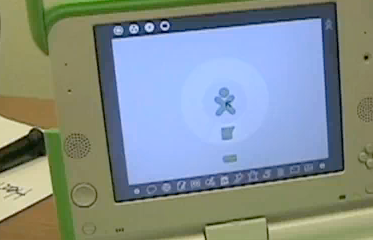
As I thought about Chapter 3, I wasn’t particularly inspired, but thought of a few topics, think.com, the reliability of Wikipedia, and open source software. As always, the more I read, the more inspired I became.
Think.com. What a great name! One of my girlfriends, PMM, says (and told her children) that the things you need to get from your education are the ability to read, write and think. Coming from a family where my father started as a math professor, I was a little concerned about leaving math out of the equation, but I’ve realized she’s right. The part of math that’s important today is the thinking part, not the ability to do simple arithmetic (although a basic understanding would be extremely helpful). Any $2.00 calculator can add, multiply, subtract and divide, it’s what you and I do with arithmetic, how we think about the problems that matters.
All that leads up to why I was probably disappointed by think.com. I had grand expectations. I wanted to see “thinking” in progress… and I couldn’t. It’s virtually all password protected so I couldn’t “see” anything, let alone observe how kids were thinking. I did check out the public spaces in and around
How about the reliability of Wikipedia? What site do you think has the most info about this subject? Why Wikipedia, of course. http://en.wikipedia.org/wiki/Reliability_of_Wikipedia Even a blog by Cathy Davidson, Duke University English professor and cofounder of HASTAC (Humanities, Arts, Science and Technology Advanced Collaboratory) said so.
http://www.hastac.org/node/1455 By the time I found her blog, I had already read Wikipedia on Wikipedia and could wholeheartedly agree. Their resources and opinions were balanced and their references extensive.
I did find another interesting article about a Cal Tech graduate student, Virgil Griffith, who developed Wikipedia Scanner, a database that tracks the wikipedia edits – even anonymous ones – with IP addresses (and who owns them). The article says he was inspired to develop it because he had heard that congresspersons were editing their own entries. (I wonder if there was bias in those entries.) Even IP addresses owned by the CIA make changes. How scary is that? In fact, it brings up an aspect of our intelligence community that I don’t even want to think about. http://www.wired.com/politics/onlinerights/news/2007/08/wiki_tracker
Finally, I checked on open source software, particularly educational open source software. There were a couple of sites that listed good math, English, etc. skills-building programs. Just looking at the pictures and descriptions, I’m not sure how they can compete against what’s being produced by the for-profit game companies. I realize that they’re not necessarily intended to compete against them, but if you played one of my son’s RPG games and then played TuxMath, I don’t see how there wouldn’t be comparisons (and dashed expectations). http://www.junauza.com/2007/12/freeopen-source-educational-software.html http://edu.kde.org/
One of the things I did notice was that there was a lot of open source production and utilities software that could be used for education or was designed for education. Lois mentioned Moodle, and of course, that’s one of the biggies. A lot of this software such as virus scan, spyware detection, etc. was developed for the general population, not just schools. http://www.schoolforge.net/
The Online Education Database listed ten success stories that have contributed to education that were developed due to the influence of the open source movement. Their number one choice was MIT who developed open courseware for over 1,000 of their classes. Other choices included Open Office, Wikipedia, Linux ... http://oedb.org/library/features/how-the-open-source-movement-has-changed-education-10-success-stories
Then there’s the article or resource that ties it all together for me. This time it came as an offshoot of Cathy Davidson’s blog. It’s a book by Christopher M. Kelty, titled Two Bits, the Cultural Significance of Free Software. http://twobits.net/ It has been released in hard copy form, but is also available for free download on the internet or can be read online. It has a Creative Commons license. A quote from the introduction that I found particularly appropriate as we discuss open source software and whether it’s really free and how it affects our future.
The results have also been explosive and include anxieties about validity, quality, ownership and control, moral panics galore, and new concerns about the shape and legitimacy of global “intellectual property” systems. All of these concerns amount to a reorientation of knowledge and power that is incomplete and emergent, and whose implications reach directly into the heart of the legitimacy, certainty, reliability and especially the finality and temporality of the knowledge and infrastructures we collectively create.
As I pondered these thoughts, I remembered the speech given by Gary Marx that I read (was it just yesterday?). He discussed the students his audience was teaching, the millennials – all of the students in this class except Lois and I – and their common traits such as their passion for justice, their global world view and I contemplate where the “reorientation of knowledge and power” will lead us.




 Posts
Posts